
Mediterranean climate, more than 2000 kilometers of coastline, an array of beautiful islands, stunning medieval towns of Split and Dubrovnik, the picturesque Plitvice National Park, Croatia is an incredible destination. Croatia has many famous landmarks to cover in one trip, but we managed to visit quite a lot of the attractions in our 2-week Croatia itinerary. The itinerary we followed gave us a chance to visit some of the famous landmarks in Croatia plus a few hidden gems too.
This post covers 20 Croatian landmarks, most are medieval landmarks, and a few natural landmarks.
Disclaimer: This helpful post contains some Affiliate links. This means that if you click on any of the links in this post (AND make a purchase) I may receive a small commission at absolutely no cost to you. As such I thank you in advance should you decide to click & buy.
Page Contents
Top 10 Famous Croatia Landmarks
Dubrovnik Old Town Walls
An UNESCO World Heritage Site, the old town of Dubrovnik is perfectly preserved and one of the famous landmarks in Croatia. Walking the old town walls has to be the highlight amongst what to do in Dubrovnik’s old town.

Built in the 10th century and later modified, Dubrovnik Old Town walls provided a formidable defence against invaders. The existing city walls were constructed mainly during the 13th–17th centuries. They are as high as 6 meters and up to 6 meters thick. The circular, hour-and-a-half walk around the fortified perimeter of one of Europe’s best-preserved medieval towns is fabulous. You can opt for a 2-hour walking tour of the City Walls and learn how the city became one of the most advanced maritime republics.
Even if you have only one day in Dubrovnik, I do recommend you to walk the Dubrovnik walls. We did this early in the morning to avoid crazy crowds and the bright sun. Just loved the views of the Adriatic Sea, the islands glimmering like green jewels and the breathtaking old town itself.
Diocletian Palace
Diocletian’s Palace is the oldest continuously-inhabited Roman palace in the world. This is the top attraction in Split and a famous Croatian landmark. On our one full day in Split, we chose to take a guided tour with a local who informed us all about its history and culture.
The Palace occupies a large area in the old town and blends in with the residential quarters, restaurants, and other buildings. Built as a military fortress, imperial residence and fortified town, the Palace measures 215m from north to south and 180m east to west. There are 220 buildings within the palace boundaries, home to about 3000 people.

Do visit the Diocletian Palace Cellars as well, they are one of the best preserved ancient complexes of their kind in the world. In the Roman times, their function was to elevate the Emperor’s chambers on the floor above, but they were also the storage area for the Palace.
Plitvice Lakes
Plitvice Lakes National Park offers a breathtaking glimpse into the natural beauty of Croatia. From cascading waterfalls to crystal-clear turquoise lakes, the enchanting landscapes and picturesque walking routes that make Plitvice Lakes a must-visit Croatian landmark for nature enthusiasts. In 1979, Plitvice Lakes National Park was added to the UNESCO World Heritage register.
The lakes are renowned for their distinctive colours, ranging from azure to green, grey or blue. 18km of wooden footbridges and pathways snake around the lakes’ edges and across the rumbling water.
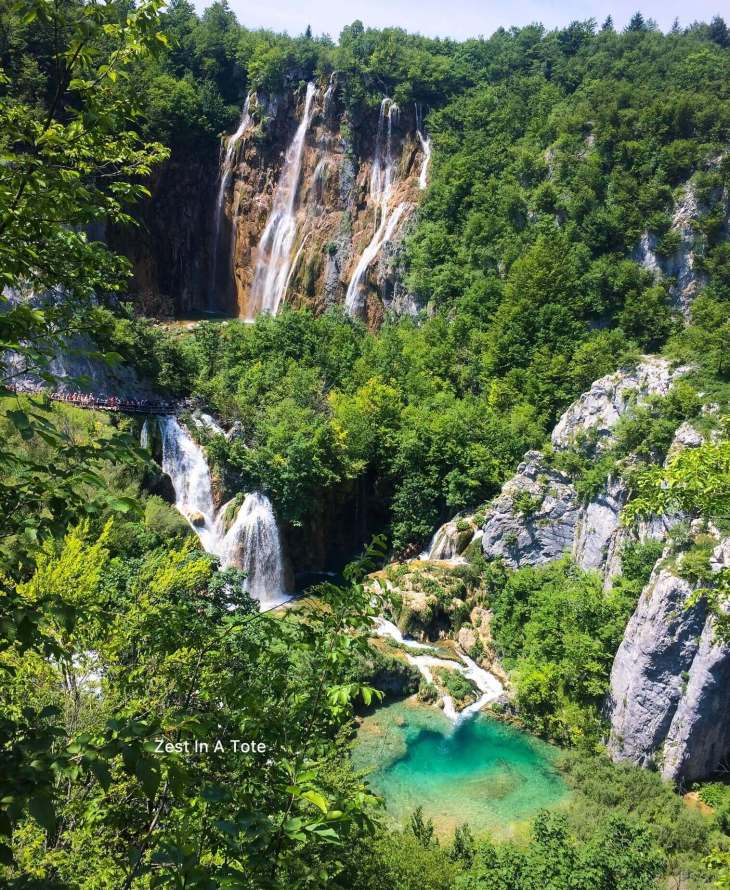
We explored the Upper Lakes and Lower Lakes on consecutive days, though it is easy to combine this in one long day. Read my comprehensive guide on Plitvice Lakes for the best travel tips, accommodation, entrance fees, how to reach the best viewpoints, walking routes to stay away from the summer crowds and more.
Fortica at Hvar Town
Its relaxed Mediterranean lifestyle, cultural heritage, delicious local cuisine and fine wines all make Hvar island one of the popular Croatian islands to visit. In 1420, Venice took proper control of Hvar island and, as it was often used as a stopping point for ships sailing between Venice and the rest of the Mediterranean. The island prospered under this rule, so much so that Hvar town became the richest area in Dalmatia.

One of the best things to do in Hvar is to visit the Fortica, or its main fortress located in Hvar town. Even if you are uninterested in its history, the views looking down over Hvar and Pakleni islands are stunning. Dating from the 16th century, the Fortica represents the onetime main fortification of Hvar town, giving centuries of protection to the town and its port. Its elaborate ground plan, picturesque location and excellent state of preservation make it one of the finest landmarks on the Croatian coast.
Zagreb Upper Town
Upper Town is the most charming part of Zagreb, in my opinion. It is definitely a must-do even if you have just 1 day in Zagreb. Traffic here is limited, and the area is full of interesting landmarks, museums and small cafes.

The colorful, tiled rooftop of St. Mark’s Church is one of the the most recognizable attractions of the city. It is one of the oldest architectural monuments in Zagreb. Its colourful tiled roof, constructed in 1880, has the medieval coat of arms of Croatia, Dalmatia and Slavonia on the left side, and the emblem of Zagreb on the right. The Gothic portal, composed of 15 figures in shallow niches, was sculpted in the 14th century. The interior contains sculptures by Ivan Meštrović, though the church is open only at Mass times.
Just before the St. Marks Church in the Upper Town, is the Museum of Broken Relationships. This is a quirky museum – all items here are relics of broken relationships.
Trogir Old Town
The historic city of Trogir is a wonderful Croatian landmark. This beautiful medieval town situated just off the mainland north of Split. The ancient town of Tragurion was founded in the 3rd century BC as a trading settlement by Greek colonists. The town has been in continuous occupation since then. it has been embellished by successive rulers with many fine public and domestic buildings and fortifications. Its Romanesque churches are complemented by the outstanding Renaissance and Baroque buildings from the Venetian period.

Today Trogir Old Town is an UNESCO World Heritage centre and a fantastic place to visit. It has the same appearance as many heritage towns along the Dalmatian coast, with its familiar stone houses, only on a much cuter scale! The centre of Trogir Old Town is layered with historic buildings, and the most prominent is St Lawrence Cathedral, right in the heart of the main square. Trogir even has its own Benedictine Monastery, which is a thousand years old.
Golden Horn beach
The Zlatni Rat, often referred to as the Golden Horn, is a spit of land located on the harbour town of Bol on the Croatian island of Brač.

Golden Horn Beach is postcard-worthy, with an iconic shape resembling a slightly-curved V and the surrounding pristine Adriatic Sea. It is no surprise that it’s a super popular destination among tourists. The hills in the background, the pine trees, the waves crashing against the shores, and the sailboats docked at the shores made for a beautiful image.
This famous beach has a serene atmosphere due to the natural surroundings and the breeze from the Adriatic Sea. But do note that the Golden Horn Beach is busy during the peak summer travel months of June to August.
Pula arena
The Amphitheatre in Pula, better known as the Pula Arena, is a Roman amphitheatre, which was once the site of gladiator fights. It was built in the 1st century AD during the reign of Emperor Vespasian, at the same time as the magnificent Colosseum in Rome. This brilliant Croatian landmark will make you wonder whether you have stumbled in Rome. Today, the Amphitheater is situated outside the old city walls because of its size and geographical configuration.

It’s one of just 6 of the world’s largest surviving Roman amphitheaters and Croatia’s best-preserved ancient monument. Not only has it managed to retain its complete circuit of walls, it’s still used for events today. It is the venue for Pula Film Festival, various concerts, opera, ballet, and sports competitions. The underground passageways once used by gladiators now host an exhibition on viticulture and olive oil production.
Sea Organ at Zadar
The Sea organ is an architectural art object located in Zadar. This wonderful landmark in Croatia is an experimental musical instrument, which plays music by way of sea waves.
The Sea Organ is designed as a group of pipes that run under large marble stairs, and the sea waves create air pressure that produces random but fairly harmoniously arranged tones in the pipes. It was designed by Nikola Basic as part of a project to restore the old town waterfront area and was presented to the public in 2005.

The Sea Organ is a relatively big tourist attraction for Zadar, especially at sunset time. Chiseled into 7 steps, 7 chords of 5 tones can be heard from this installation, all changing as you make your way down the promenade. When the tides are calm with a gentle lull, the sounds are more peaceful and harmonious. When the waves become more powerful, a lively and boisterous sound gets emitted from the strength.
Rovinj Old Town
Rovinj is often called the prettiest town in Istrian peninsula of Croatia. The closest airport is Pula Airport, just 40 minutes away by car. With its pastel-colored houses, cobbled alleys, and that dreamy peninsula setting, it’s one of the most beautiful places to visit in Croatia.

Rovinj old town is built on a hilly peninsula, with narrow, cobblestone alleys that twist and turn between colorful houses, little art galleries, and secret staircases. This car-free old town is a great place in which to get lost. At the very top of the old town you’ll find St. Euphemia’s Church, Rovinj’s most iconic landmark. The view from the top of St. Euphemia Church is outstanding, taking in the harbor, islands, and 360-degree views of the landscape.
Other landmarks to visit in Croatia
Ston walls
Have you heard of the ‘Great Wall of Europe’? We went on a scenic drive from Split to Dubrovnik and visited Ston en route. Climbing Ston walls and taking the stunning aerial views over the area has to be the best thing to do in Ston Croatia. These famous walls were used to depict the city walls of King’s Landing in the HBO series ‘Game of Thrones’. And being a GoT fan, visiting one of the iconic Game of Thrones filming locations in Croatia was awesome for me.

The well-preserved Ston Wall dates back to the 13th century when they were built by the Republic of Ragusa to protect the city from invaders. Today, the Walls of Ston are one of the world’s longest preserved fortification systems, comprising of 40 towers and 5 fortresses. It stretched for 7 km when it was built and today about 5.5 km of the Ston wall still stands.
Krka national park
Extending along the 73km Krka River, Krka National Park runs from the Adriatic near Šibenik inland to the mountains of the Croatian interior. It’s a beautiful place of waterfalls and gorges, with the river gushing through a karstic canyon 200m deep. The attractions and facilities available include various boardwalks, sightseeing tours and presentations, boat trips, souvenir shops, a museum, and restaurants.

Skradinski Buk is the most popular waterfall at Krka National Park. It is a massive, clear, natural pool with high waterfalls at one end and cascades at the other. There are other lovely spots to visit in Krka NP. Like a tiny island in the middle of nowhere that houses the Visovac monastery. This island consists of only the small monastery with a garden so it is an incredibly peaceful place.
Blue Cave in Biševo
The small island of Biševo lies in the immediate vicinity of Vis island. Biševo is an island of caves whose wondrous formations are one of the best natural landmarks of Croatia. The Blue Grotto or the Blue Cave is a popular tourist attraction worth visiting for its luminous blue water. It is one of the best things to do from Vis island, and also forms a popular day trip from Hvar island. onsider taking this tour from Hvar island for a day of fun: Blue & Green cave group tour

The light effects created by the refraction and reflection of sunlight off the sea floor are especially impressive, forming a surreal blue light that fills the inside of the Blue Cave. The intensity of the blue colour can vary depending on the time of day and the weather conditions, with the most vibrant hues typically observed around midday when the sunlight is at its peak. This natural phenomenon is one of the most famous caves in the Adriatic Sea.
Loverjinac Fortress
Lovrjenac fortress, also called Dubrovnik’s Gibraltar, is outside the western wall of the old town. This 14-century fortress is built on a 37 m high sea rock. Initially built to defend the western part of Dubrovnik’s Old Town, it was established as a defensive position for the whole city.

The origins of Lovrjenac reach back to the years 1018 and 1038, while the first preserved mention of the fortress dates from 1301. In addition to the buildings for the garrison, the fortress also contained the Church of St. Lawrence and the House of pious women of the Third Order who tended the church. It now stages world-class theatre and summer festivals. You can visit this Fortress daily from 8 AM until 7 PM. You can also take a Game of Thrones tour that includes a visit to Fort Lovrijenac.
Mljet national park
Mljet island is one of the popular Croatian islands to visit from Dubrovnik. Half the island is a national park, full of hiking and cycling trails that go around two beautiful lakes. The other half has dramatic cliffs with jaw-dropping views of the islands around it and a world-class sandy beach. As the oldest marine park in Croatia, Mljet National Park is a verdant sanctuary where lush forests and turquoise waters of the Great and Small Lakes provide the perfect backdrop for an idyllic retreat.

The access to Mljet national park is on the north or west coast through villages Pomena and Polače. Both the lakes in Mljet park are encircled by well-marked paths, you can cycle or stroll along the pleasant, shaded footpaths. A highlight of the Great Lake is the scenic islet of St Mary’s, boasting a magnificent 12th-century monastery where you can enjoy a refreshing swim alongside its historic walls. Swimming and sunbathing in the park is good fun, and kayaking is allowed too. You can take a hike up the hills to enjoy the stunning scenery from there above the Mljet coastline.
Šibenik Old town
Just north of the city of Split, the city of Šibenik provides a relaxed blend of history and natural beauty. Šibenik was founded by Slavs at least as early as 1066 AD and, as such, is considered the oldest Croatian town on the Adriatic Coast. If you are considering making Split as your base over Dubrovnik, proximity to Šibenik and Trogir for day trips do matter.

Begin your historical tour of the old town at the Cathedral of St James, one of the city’s 2 UNESCO World Heritage Sites. The Cathedral is the most important architectural monument of the Renaissance in the entire country. It is also the filming location in Game of Thrones for the most powerful financial institution in the Free World: The Iron Bank.
Another of the city’s major historical sights is the imposing St. John’s Fortress. This is an early modern fortress situated atop a hill north of the city’s historical center. It was named after a medieval church dedicated to St. John the Baptist that had stood there from at least 1444.
Klis Fortress
The town of Klis lies about a 20-minute drive outside Split city. This is an impressive mountainside location with exceptional views of Split and the Adriatic Sea. For over its 2,000-year history, this area has been a royal castle and seat of many Croatian kings. At the center of this hillside village is a medieval fortress built into a rocky ridge giving visitors an incredible bird’s eye view of the entire Split area, Adriatic Sea, and surrounding islands.

Klis was a fortress during the Ottoman wars, with its last military occupation being by the Axis powers during World War II. GoT fans will recall Klis as the City of Mereen. It is most memorable as the location where Daenerys seizes the city and frees the slaves from their masters before nailing them to crosses.
Mount Hum, Vis island
Mount Hum is a mountain located on the island of Vis, Croatia. It is the highest elevation point of Vis with its 587 metres. Vis is one of the most intriguing and picturesque islands, famous for its untouched nature, secluded beaches, and dark, yet fascinating military history.

On our trip to Vis island, we did drive to Mount hum as part of an interesting Military Tour with a local guide. The very top was off limits, but we did drive up and parked a little before the end of the road. A military radar station is located on the top and the peak is not accessible to civilians.
A short path led to a lookout offering jaw-dropping views over Komiža. You can also see the little Holy Spirit Chapel. Tito used a cave on the mountain as his headquarters during WWII. The start of the track to Tito’s Cave is no longer signposted, but it was easy to get to with our local guide.
Korčula Old Town
Korčula is a stunning Croatian island, brimming with natural beauty, from the postcard-perfect vineyards to the charming Medieval old town and landscape dotted with stone houses. At times overshadowed by Hvar island, it is a must-visit destination in Croatia. Korčula Old Town is a picturesque, medieval walled city on the Dalmatian peninsula known as ‘Little Dubrovnik‘. The old town features Venetian-inspired architecture and a unique fishbone-patterned street layout designed for wind protection. Located on the northeast coast of Korčula Island, the town is the beating heart of the island. It is home to boutique hotels, restaurants, bars, churches, tour agencies, water taxi stands and the main tourist port.

Amongst the many attractions to explore in the town, do visit the St. Mark’s Cathedral. This is a 15th-century Gothic-Renaissance cathedral located in the main square, featuring a bell tower with panoramic views. Also explore the Marco Polo’s House, known as the debatable birthplace of the famous explorer. The site offers a small museum and tower access.
Brijuni national park
Off the coast of Croatia’s Istrian peninsula, Brijuni park is a true blend of natural beauty and historical significance. The park comprises a 14-island archipelago. This popular tourist destination in Croatia, is famous for exploring Roman ruins, a safari park, and 100-year-old golf courses, accessed via ferry from Fazana. Known as the former summer residence of Yugoslav leader Josip Broz Tito, the islands are rich in 20th-century history and culture.

Veliki Brijun, the archipelago’s largest island, offers a safari park, dinosaur tracks from the Cretaceous Period, and historical sites, including Roman villa ruins. It also houses a museum showcasing Brijuni’s history and its appeal as a retreat for dignitaries and celebrities. You can hop on the island’s tourist train (or rent a golf cart) to journey into the safari park, home to zebras, llamas, and its famous Indian elephant. The Ulysses Theatre, an open-air stage set in an abandoned Austro-Hungarian fort, hosts a lively series of summertime plays and concerts.
____________________________________
Pin it for later!


____________________________________
If you’ve been to Croatia, what was the favourite attraction?
Join me on Instagram, Pinterest and Facebook as I share my travel experiences.


I’ve only been to Dubrovnik. I have so much more to see in Croatia.
For sure, so many amazing places there.
I’ve only been to Dubrovnik and Zagreb but there’s so much to see in this beautiful country! Thank you for the inspiration!
Yes, the islands are quite something.
Croatia looks absolutely breathtaking! This list really highlights how diverse the country is—from historic cities to stunning natural wonders. Plitvice Lakes has been on my bucket list for ages, and seeing places like Dubrovnik and Split featured here makes me want to plan a trip even more
You got that right – diverse, from medieval towns to beautiful islands to national parks. Hope you get to visit soon.